
Grounded presence is your natural state
That's what I've found, anyway. Let's find out what's pulling you away from it.

I'm Joel, and I'm starting out as a meditation and awareness coach.
While I build experience and complete my life coaching qualification, I'm offering free 30-minute coaching calls to a small number of people (15 spots). First in, first served.
There's no sales pitch and no obligation. If it's useful, I'd value your honest feedback afterwards.
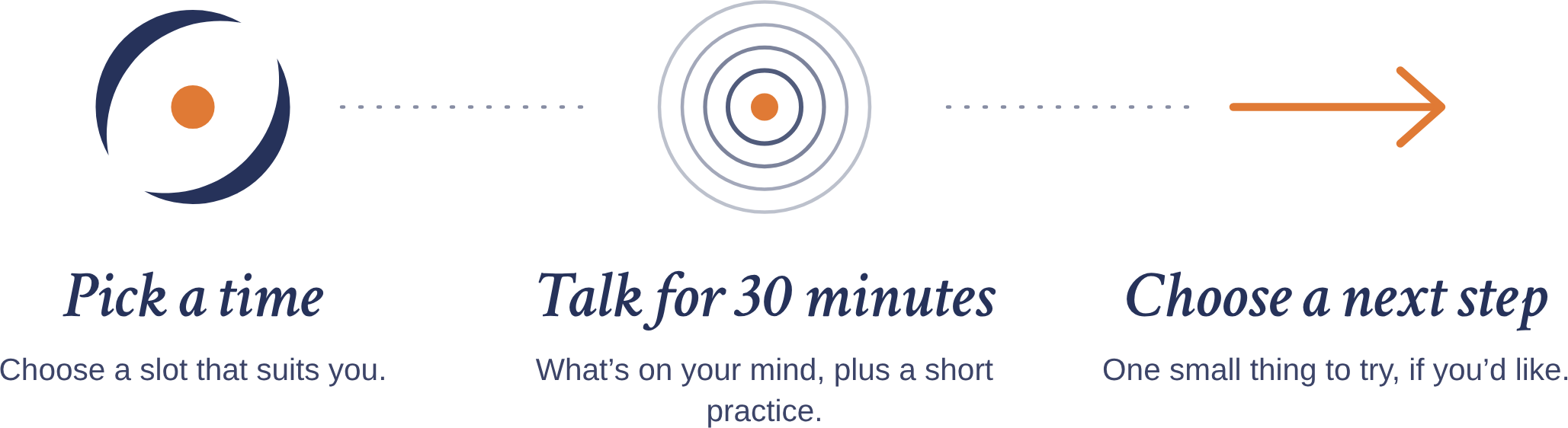
How it works

Frequently Asked Questions
Curious about coaching, meditation, or what I do differently? Here are a few things you might be wondering. If there's something else you'd like to know, feel free to get in touch.
-
Life coaching is an opportunity to step back from the demands of everyday life, explore what's happening within you, and develop a clearer understanding of where you'd like to go.
Sometimes we feel stuck, overwhelmed, disconnected, or uncertain about what we want. Other times, we simply know there's more to explore.
Through conversation, reflection, and practical tools, coaching helps you develop greater awareness, navigate challenges, and take meaningful steps towards a life that feels more aligned with who you are and what matters to you.
-
Coaching is for anyone interested in understanding themselves better and living more consciously.
Perhaps you're feeling stuck, struggling with your emotions, navigating a difficult situation, or questioning the direction of your life. Maybe you're simply curious about personal growth and want to explore your potential.
You don't need to have everything figured out or arrive with a specific goal or issue. Sometimes, discovering what matters to you is where the journey begins.
-
My approach is centred around awareness, emotional understanding, and meaningful action.
I believe that lasting personal growth begins with understanding our experience rather than simply trying to change it. By developing awareness of our thoughts, emotions, behaviours, and patterns, we can begin to understand ourselves more deeply and respond to life with greater intention.
This is reflected in my See–Feel–Move framework:
See: Develop awareness and understand what's happening within you.
Feel: Learn to consciously experience and navigate your emotions.
Move: Translate that understanding into meaningful action and personal growth.
The intention isn't to give you another set of rules to live by, but to help you develop the understanding and confidence to find your own way.
-
See for Yourself is built around a simple idea: experience before belief.
We're constantly influenced by ideas, assumptions, expectations, and the opinions of others. While these can be valuable in certain cases, they can also prevent us from seeing things clearly for ourselves.
I believe there's tremendous value in slowing down, becoming aware of our experience, and exploring life with an open mind.
Rather than simply telling you what to believe or how to live, I encourage you to question, explore, and discover what you can understand through your own experience.
Ultimately, the most meaningful insights are those you come to see for yourself.
-
Not at all.
You don't need to follow a particular religion, adopt a spiritual belief system, or have any previous experience with meditation.
My approach is grounded in personal experience, awareness, and practical exploration. You can engage with these ideas in whatever way feels meaningful to you.
-
Coaching and therapy can both provide valuable support, but they generally serve different purposes.
Coaching tends to focus on self-understanding, personal development, navigating life challenges, and moving towards meaningful goals.
Therapy may involve clinical assessment and treatment of mental health conditions, psychological distress, or difficulties that require specialised care.
Coaching isn't a substitute for therapy or professional mental health treatment. If you're experiencing difficulties that require clinical support, I encourage you to seek help from an appropriately qualified professional.
-
Each session is shaped around you, your experiences, and what you'd like to explore.
We might discuss a particular challenge, explore recurring thoughts or emotional patterns, reflect on your values and direction, or work through practical strategies for moving forward.
There's no expectation that you need to arrive with the right answers. Sometimes the most valuable part of coaching is simply having the space to slow down, reflect, and see something from a different perspective.
My role is to support your exploration, ask thoughtful questions, and help you develop your own understanding.
-
Not at all. This is one of the most common misconceptions about meditation.
The mind naturally produces thoughts, just as the body naturally produces sensations. Trying to force these experiences to disappear can often create more frustration than awareness. However, as a result of consistent practice in mindfulness, the mind can slow down and stop altogether. This is what I have experienced from 8 years of practice every day.
Meditation is about learning to become more aware of what's happening within you, without automatically getting caught up in every thought, emotion, or sensation.
It's not about controlling every experience. It's about developing a different relationship with the experience that's already happening.
-
Meditation is one of the foundations of my approach to personal development. It is the most important part of my approach
I see it as a way of developing awareness — learning to observe our thoughts, emotions, and experiences without becoming completely caught up in them.
This awareness extends beyond formal meditation into everyday life, helping us understand ourselves more clearly, navigate our emotions, and respond to life's challenges with greater intention.
For me, meditation isn't simply something we practise for a few minutes each day. It's a foundation for living more consciously.
-
That's completely okay - and quite common.
Many people come to personal development with a sense that something isn't quite right, without necessarily knowing what needs to change.
You don't need to have a clear vision, a specific goal, or all the answers before beginning.
Sometimes clarity emerges through the process of slowing down, understanding yourself, and exploring what genuinely matters to you.
We can start wherever you are.
-
The best place to start is with an introductory coaching conversation.
It's an opportunity for us to get to know each other, explore what you're looking for, and discuss whether coaching might be a good fit.
There's no pressure or obligation to continue. It's simply a chance to have a conversation and see where it leads.